Stories13.11.2026
Scandinavian Folk Art: Motifs, Traditions and the Stories in Our Prints
Scandinavian folk art is the decorative art of the rural Nordic home: flowers and scrolls painted on cupboards and walls, horses carved from wood, and heavy pile rugs knotted in bright wool.
Each country has its own voice, from Norwegian rosemaling and Swedish Dala painting to the Finnish ryijy. What unites them is pattern with a purpose, made by hand to bring colour and story into everyday life.
Below is a short guide to the motifs, colours and regional styles, and to how the folklore and forests of Finland run through Klaus Haapaniemi's work.
Key takeaways
- Scandinavian folk art grew up in farmhouses, where painters, weavers and carvers decorated the objects of daily life.
- Its motifs are stylised flowers, scrolls, birds, horses and trees, in deep reds, blues, greens and ochres.
- Norway is known for rosemaling, Sweden for Dala painting and kurbits, and Finland for the ryijy rug.
- Klaus Haapaniemi's work draws on Finnish folklore and nature, retold in print, glass and wool.
What is Scandinavian folk art?
Strictly, Scandinavia means Denmark, Norway and Sweden. In design writing the word usually stretches to include Finland, which is why you will also see the wider term Nordic folk art. Either way, the subject is the decoration that country people made for their own homes, at its richest in the eighteenth and nineteenth centuries.
Much of it was the work of local craftspeople and travelling painters who moved from farm to farm. They painted chests, cupboards, bowls and wall hangings. Weavers made textiles for beds and weddings, and carvers shaped spoons, boxes and toys.
The pieces were practical first. A painted chest still held linen, and a ryijy still kept a bed warm. Decoration turned them into heirlooms, and often into a family record, with initials and dates painted or woven into the design.
Motifs and colours to recognise
Scandinavian folk art patterns share a vocabulary that is easy to learn once you start looking:
- Stylised flowers. Roses, tulips and rosettes, drawn flat and often mirrored, growing from a single stem or a vase.
- Scrolls and vines. The flowing C and S curves of Norwegian rosemaling grew out of the acanthus leaf of baroque ornament.
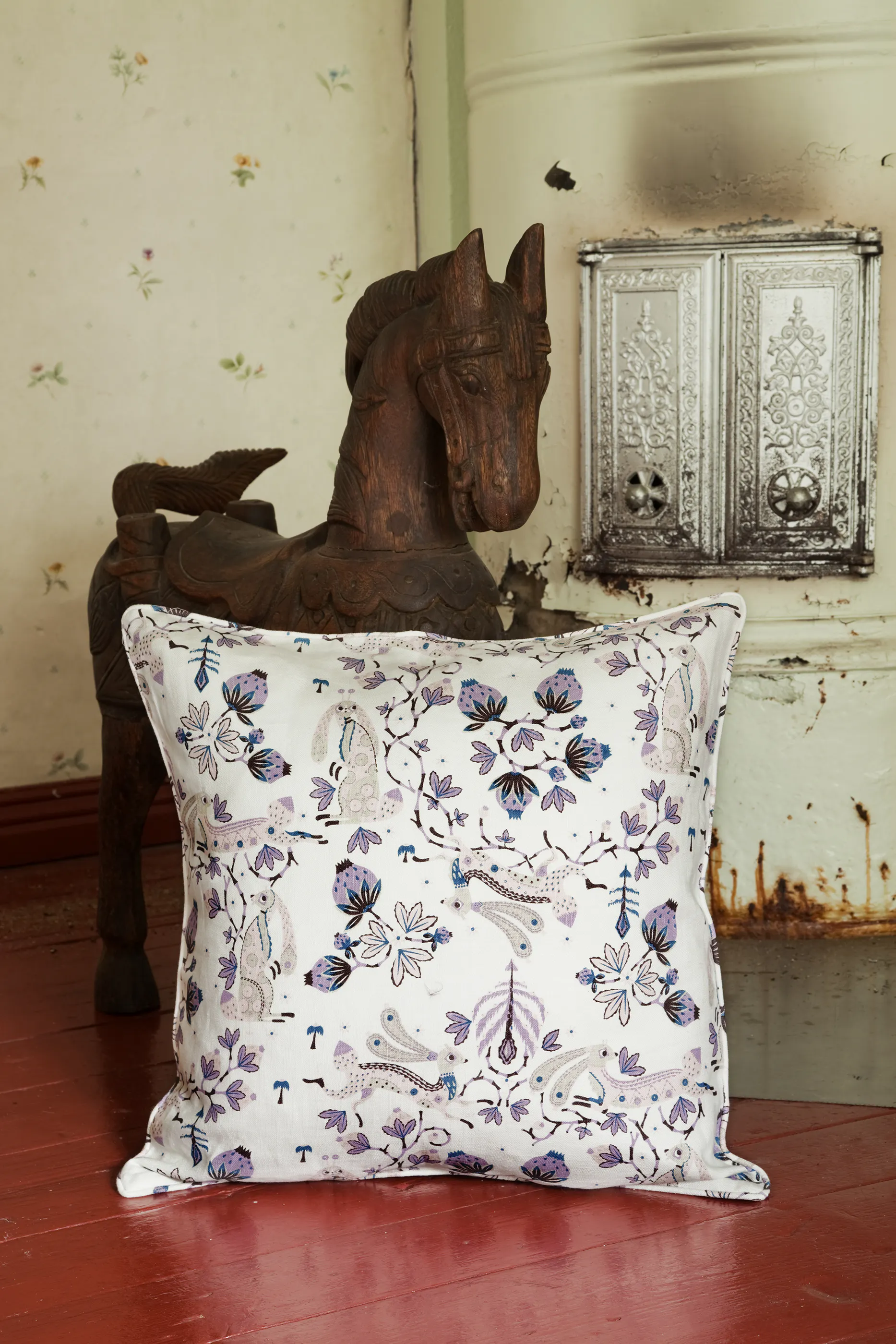
- Animals. Horses and birds appear on painted furniture, in textiles and as carved toys.
- Trees. Trees of life and slender pines, frequently set in symmetrical rows.
- Geometry. Diamonds, zigzags and eight-pointed stars in woven and knitted textiles.
Colour is just as recognisable. The palette leans to brick red, deep blue, bottle green, ochre and white, often laid on a dark or coloured ground. In Sweden the same red covers whole farmhouses as Falu red, a paint made with pigment from the copper mine at Falun.
Three regional traditions
Each region of the North developed its own hand. These three are the best known:
- Rosemaling, Norway. The word means "rose painting". It spread through rural Norway on furniture, chests, bowls and the walls of farmhouses, and each valley developed its own style. Many still carry district names, such as Telemark and Hallingdal: Telemark painting is loose and asymmetrical, built from long scrolls, while Hallingdal is more symmetrical, with fuller flowers.
- Dala painting and kurbits, Sweden. In Dalarna, painters decorated wall hangings and furniture with large, swelling plants called kurbits. The name comes from the Latin word for gourd, after the plant that sheltered the prophet Jonah in the Bible. Biblical scenes were often painted with the figures in local dress. The carved Dala horse, painted with flowers and harness, comes from the same region.
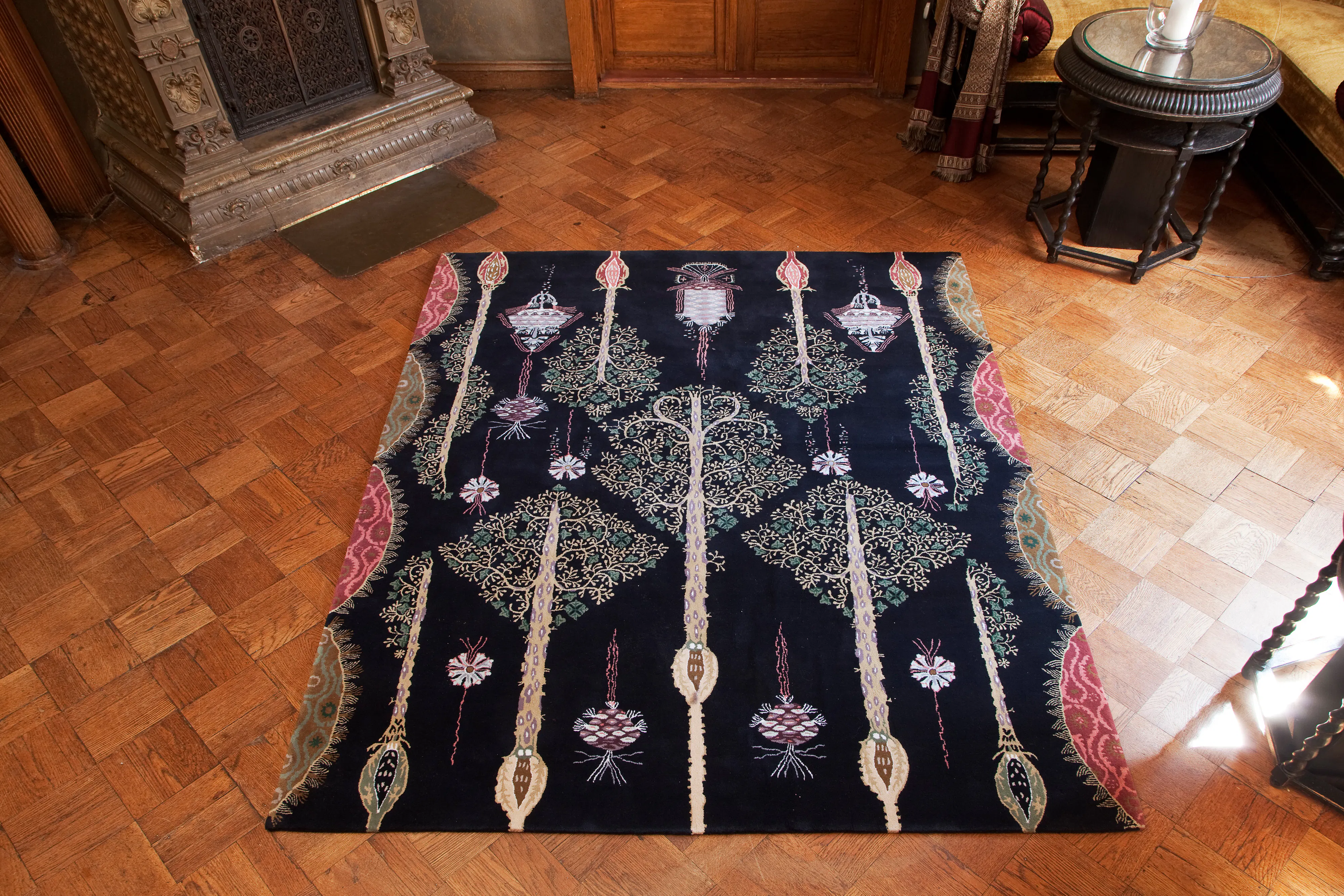
- The ryijy, Finland. The ryijy (rya in Swedish) is a long-pile rug knotted in wool. Early ryijys were working textiles, used as bed covers for warmth. Over time they became decorative pieces, made for weddings, hung on walls and filled with initials, dates, flowers, trees and animals. In the twentieth century Finnish artists and designers took the form up again.
In the far north, the Sámi have a distinct craft tradition of their own, called duodji, with its own materials and meanings. It deserves a story of its own, and we leave it to Sámi makers to tell.
Finnish folklore and the Kalevala
In Finland, a great deal of the folk tradition lived in poetry and song. In the nineteenth century Elias Lönnrot collected those oral poems and shaped them into the Kalevala, first published in 1835. It gave Finland a national epic of singers, smiths and sorcerers, and painters such as Akseli Gallen-Kallela turned its heroes into images.
Pohjola is the name of the cold northern realm in the Kalevala. It is also the name of one of Helsinki's most remarkable buildings. Completed in 1901, the House of Pohjola has a stone façade crowded with forest trolls, witches, ghouls and giants drawn from Finnish myth. Our studio works inside its vaults, and after years of drawing in its shadow Klaus put those creatures on a T-shirt. You can read that story in Pohjola: wearable folklore.

How Klaus Haapaniemi's work draws on folklore and nature
Klaus Haapaniemi & Co. was founded in 2010 by designer Mia Wallenius and artist Klaus Haapaniemi. From the start the house has been heavily influenced by Finnish folklore and the mysteries of nature. Klaus works in narrative: each project begins with a rich story, which becomes an intricate print.
You can follow that thread across very different objects. His Taika series for Iittala, launched in 2007, is loved for its folkloristic and mystical patterns, and taika is the Finnish word for magic. For his Voyagers exhibition at the Lahti Museum of Visual Arts Malva, he worked with carpenters, glassblowers and a traditional Yule goat maker.
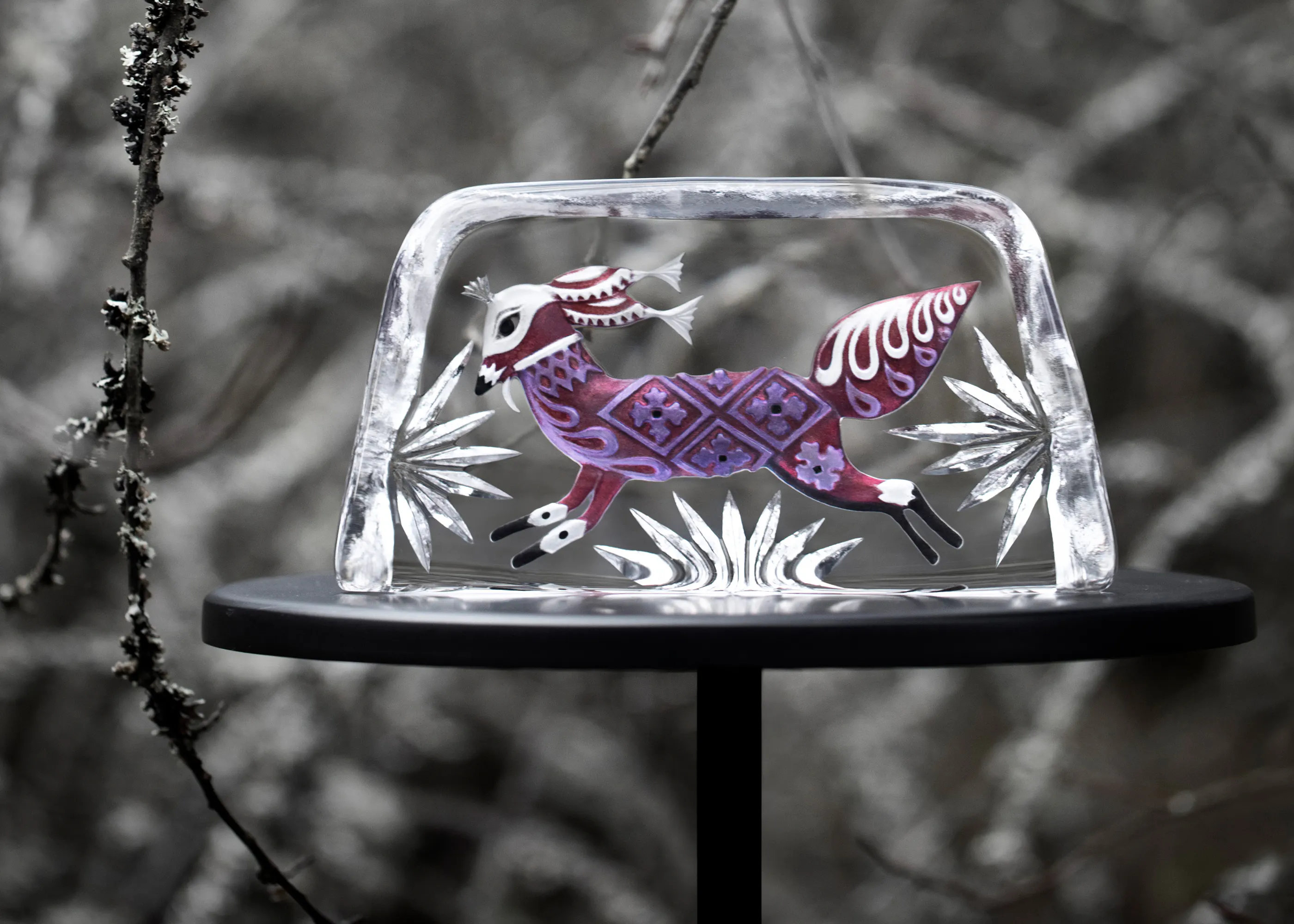
Folklore takes solid form in Tales from Wilderness, a series of crystal animals and creatures from folklore made with Målerås Glasbruk, a glassworks in Småland, Sweden, where every step of production is done by hand. The Tales from Wilderness Fox runs across a 19 x 10 cm block of crystal, its plum and lilac body patterned with diamonds and small flowers.
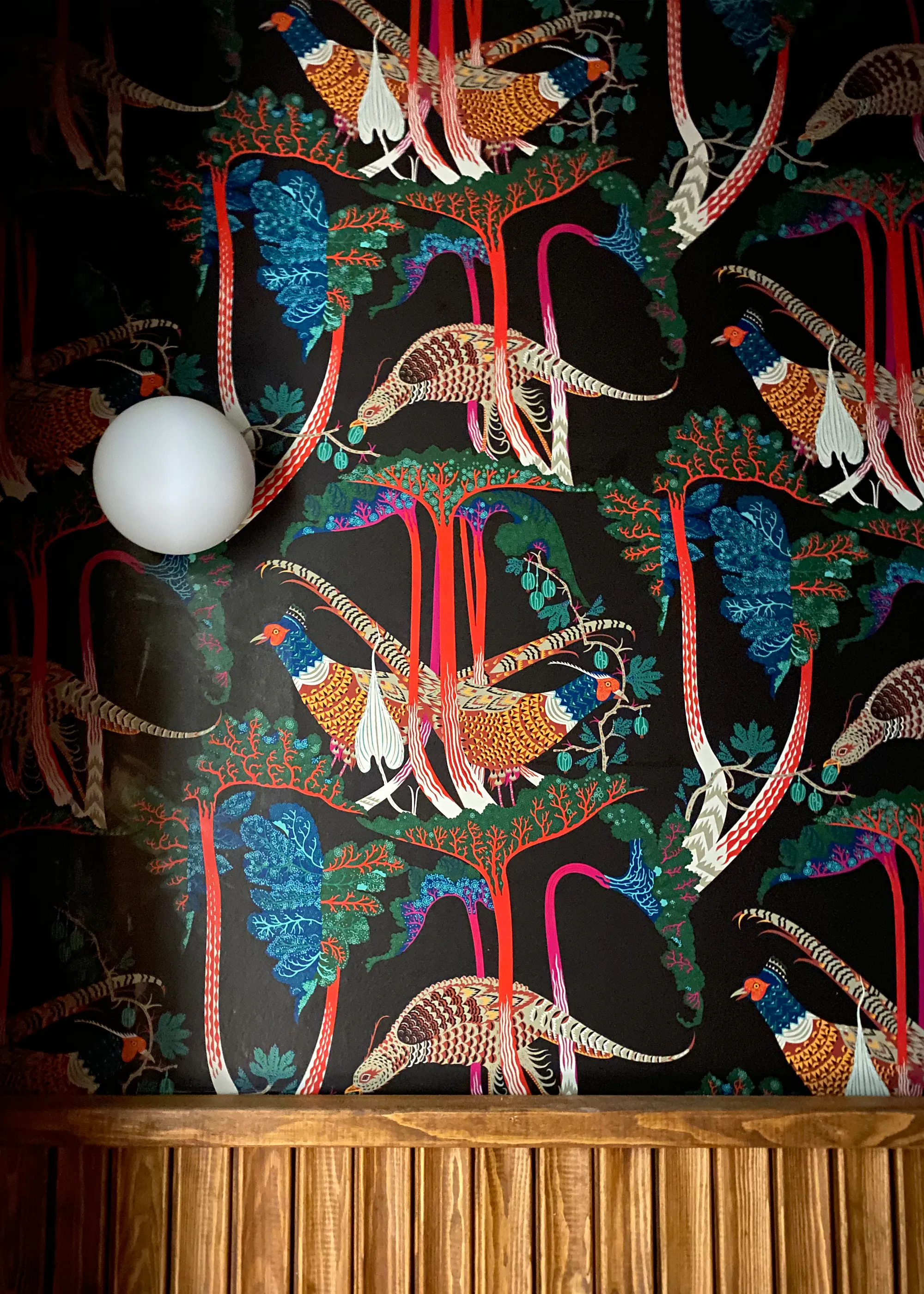
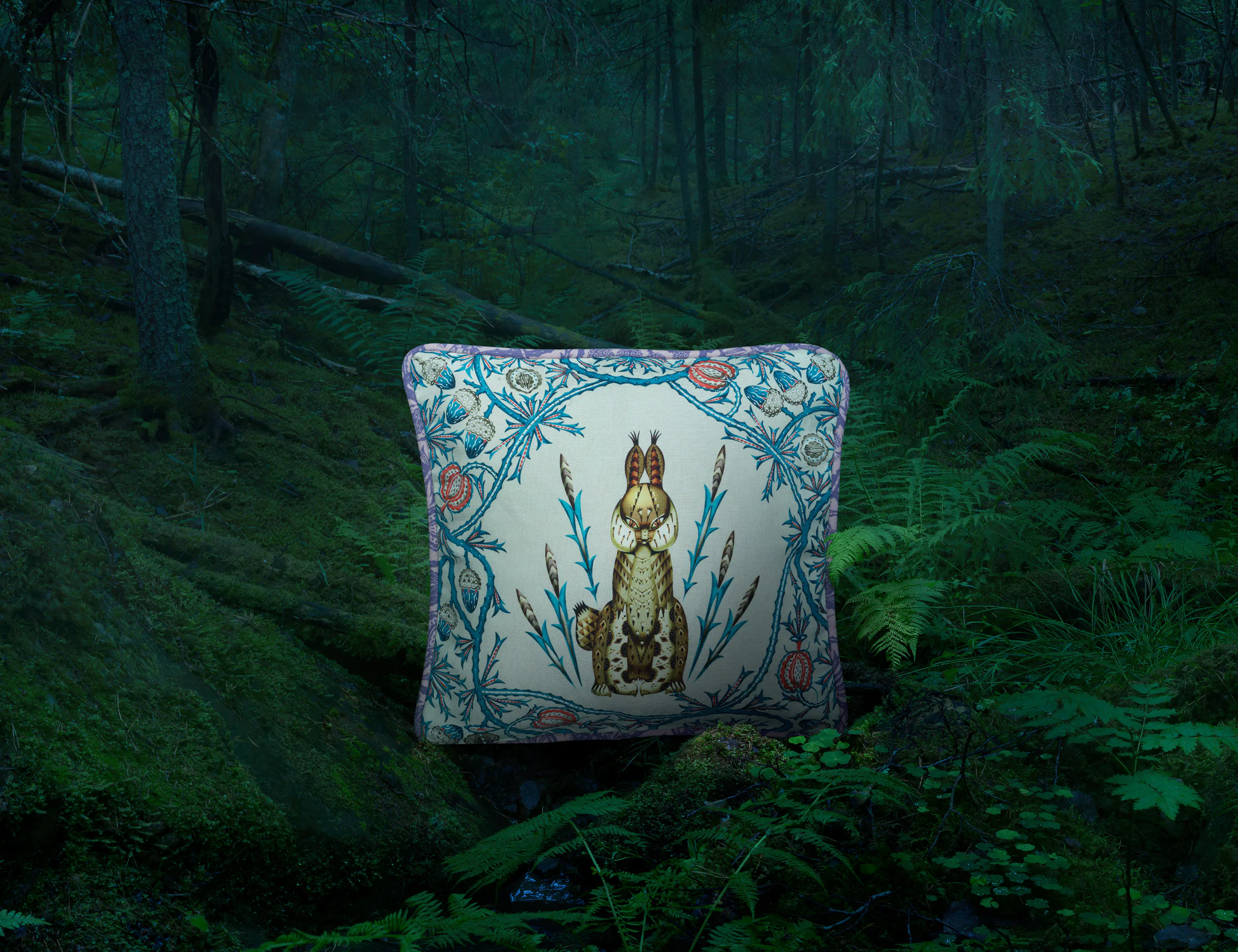
The forest is the other great source. The Lynx Sunlight cushion shows the "magnificent wild cat of Finnish forests" sitting upright among blue thistle stems, printed on linen. On the Woodpeckers velvet cushion, a mystical scene from a Finnish forest unfolds: red-capped toadstools and a dark bird at the centre, framed by a border of woodpeckers. Memory plays its part too. The Pheasants and Rhubarbs print comes from Klaus's childhood garden, where pheasants walked under the rhubarb leaves stealing gooseberries.
Purple Haze: a rya rug for today
The clearest meeting of Klaus Haapaniemi's work and Finnish craft is the Purple Haze rya rug, or Purppurahämy Ryijy. It was made in 2012 by The Friends of Finnish Handicraft, an organisation founded in 1879 to cherish and renew the textile tradition. Art weavers Kariina Linna and Sanna Reinikainen spent nine weeks on it.
The design began as a large-scale print first shown in 2006, at Klaus's first solo exhibition in Seoul. A herd of horses gallops out of birch trees into a darkening forest, in pink, blue and white, their bodies scattered with flowers and dots. Horses are a typical subject of traditional ryas, and the decorative patterns recall traditional Finnish handicraft.
The piece measures 8 square metres and is made of 93,288 piles in 100% worsted yarn, using 37 colours and 17 blended yarns. It is listed both as a rug and as a wall hanging, and there is only one.

Bringing Scandinavian folk art into your home
Folk art was made to be lived with, so it sits happily in a modern room. A few principles help:
- Start with one strong piece. A rya on the wall, a patterned wallpaper or a painted cupboard sets the tone for everything around it.
- Repeat a colour. Pick one shade from your boldest pattern, such as a brick red or deep blue, and let it return in a cushion or a glass object across the room.
- Mix the handmade and the printed. A crystal animal on a shelf, a printed linen cushion and a woven throw give the room the layered feel of a farmhouse interior.
- Use pattern on the walls. Folk art wallpaper brings ornament to a whole room at once. Our Trees wallpaper sets rows of stylised golden pines on a grey ground, mirrored like a woven textile.
Plenty of Scandinavian wallpaper today is pale and quiet. If you would like to go further, our fabric and wallpaper collection is full of creatures and flowers. For more on mixing pattern, colour and story, read our guide to maximalist decor.
Frequently asked questions
What is Norwegian folk art called?
The best-known Norwegian folk art is rosemaling, which means "rose painting". It is a style of decorative painting with flowing scrolls and stylised flowers, used on wooden furniture, chests, bowls and the walls of rural homes. Norway also has a strong tradition of decorative wood carving.
What are the different types of rosemaling?
Rosemaling styles are named after the districts where they developed. Telemark style is asymmetrical and built from long, flowing scrolls, while Hallingdal style is more symmetrical, with fuller flowers and stronger outlines. Other regional styles include Rogaland and Os.
What does the Swedish Dala horse symbolise?
The Dala horse is a carved wooden horse from Dalarna in central Sweden, painted, most often in red, with flowers and a decorated harness. It began as a toy made by local woodcarvers and has become a symbol of Sweden and of Swedish handicraft.
Find the story in your home
Scandinavian folk art turned everyday objects into stories, and that is still what a good print can do. Explore our home collections, where every pattern begins with a tale from the forest, the garden or Finnish myth.
Klaus Haapaniemi & Co. is a Finnish design house that designs, prints and produces its own homeware and clothing, founded in 2010 by designer Mia Wallenius and artist Klaus Haapaniemi.