Stories23.10.2026
How to Wear a Kimono: From the House to the Evening
A printed kimono is one of the most generous pieces in a wardrobe.
The same garment can be a robe for a slow morning, a light coat over jeans and a vest top, and with a belt at the waist, an evening dress. How to wear a kimono comes down to two choices: wear it open or wrap it closed, and decide what goes underneath. Everything else is about letting the print do its work.
This guide is about the kimono robe. We call ours kimono robes: loose, wrap-front garments with wide sleeves, inspired by the Japanese cut. A traditional Japanese kimono is a different garment. It is longer, with different sleeves, and it is worn over several other garments and tied with an obi sash. Below is how we wear our own printed kimono robes, from the house to the evening.
Key takeaways
- Wear a kimono open as a light coat, or wrap and belt it as a robe or a dress.
- Keep what goes underneath plain, so the print stays the focus.
- Pair a kimono with matching printed trousers for a full look in one story.
- Wrap the left side over the right, as the kimono tradition does.
What makes a kimono robe different
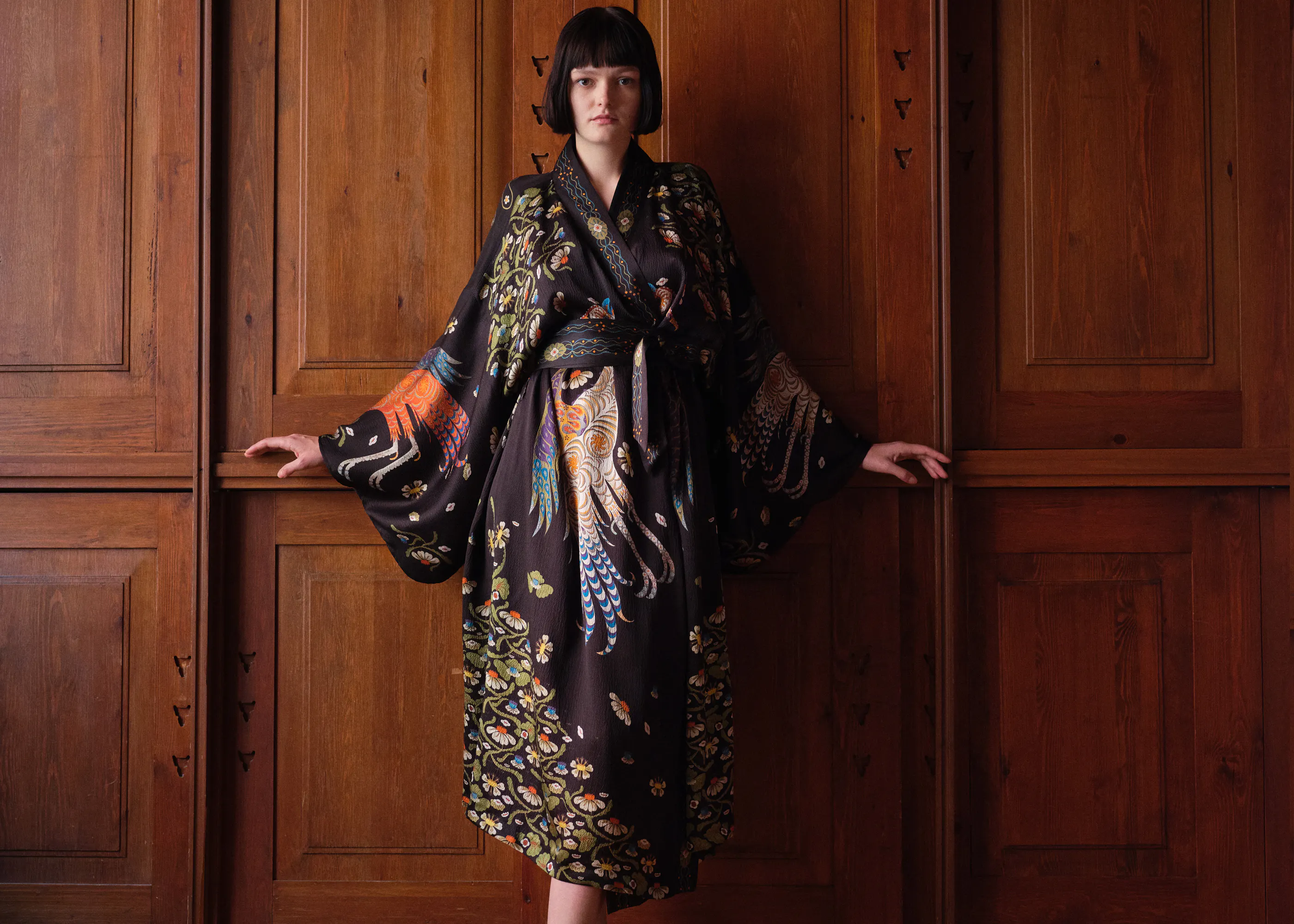
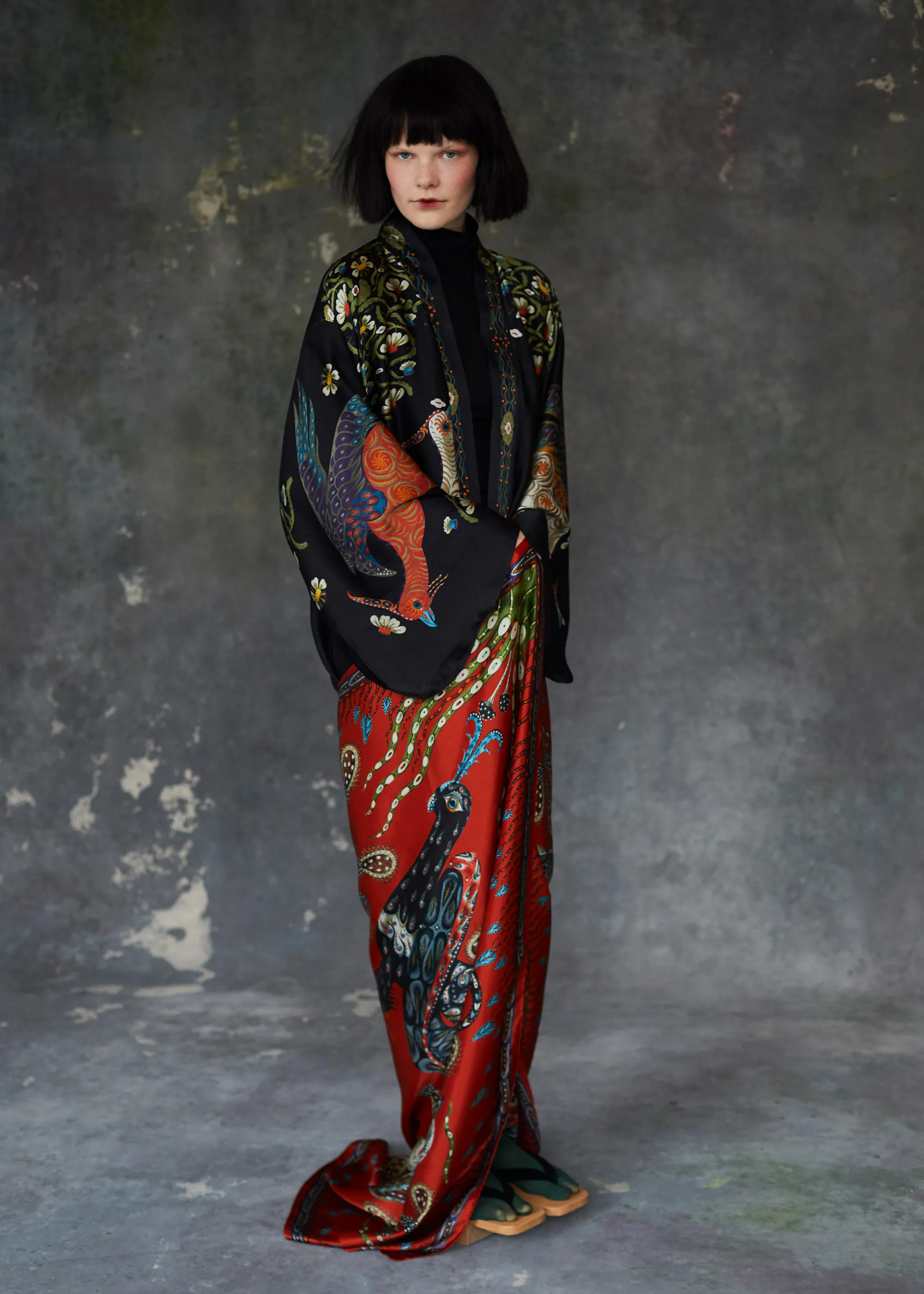
A kimono robe is cut from straight panels, with wide sleeves, an open front and a belt or sash to close it. The cut is simple and generous, which is why it suits so many shapes and so many occasions. It also gives a printed design a broad, uninterrupted canvas. Across the back of our Firebird kimono, the Firebird takes flight in terracotta orange among bold birds and foliage, a print inspired by the Ballets Russes' Firebird and the old tale of a bird with powers both good and evil.
All our kimonos are pure silk. The finish of the silk changes how it looks and feels:
- Pearl satin is 100% silk with a subtle, pearly surface. The silk is crinkled slightly to create the texture, so it catches the light softly as you move.
- Hammered silk satin is the same weight, with a more pronounced texture. Its surface is less prone to thread pulls, which makes it a little less delicate for everyday wear.
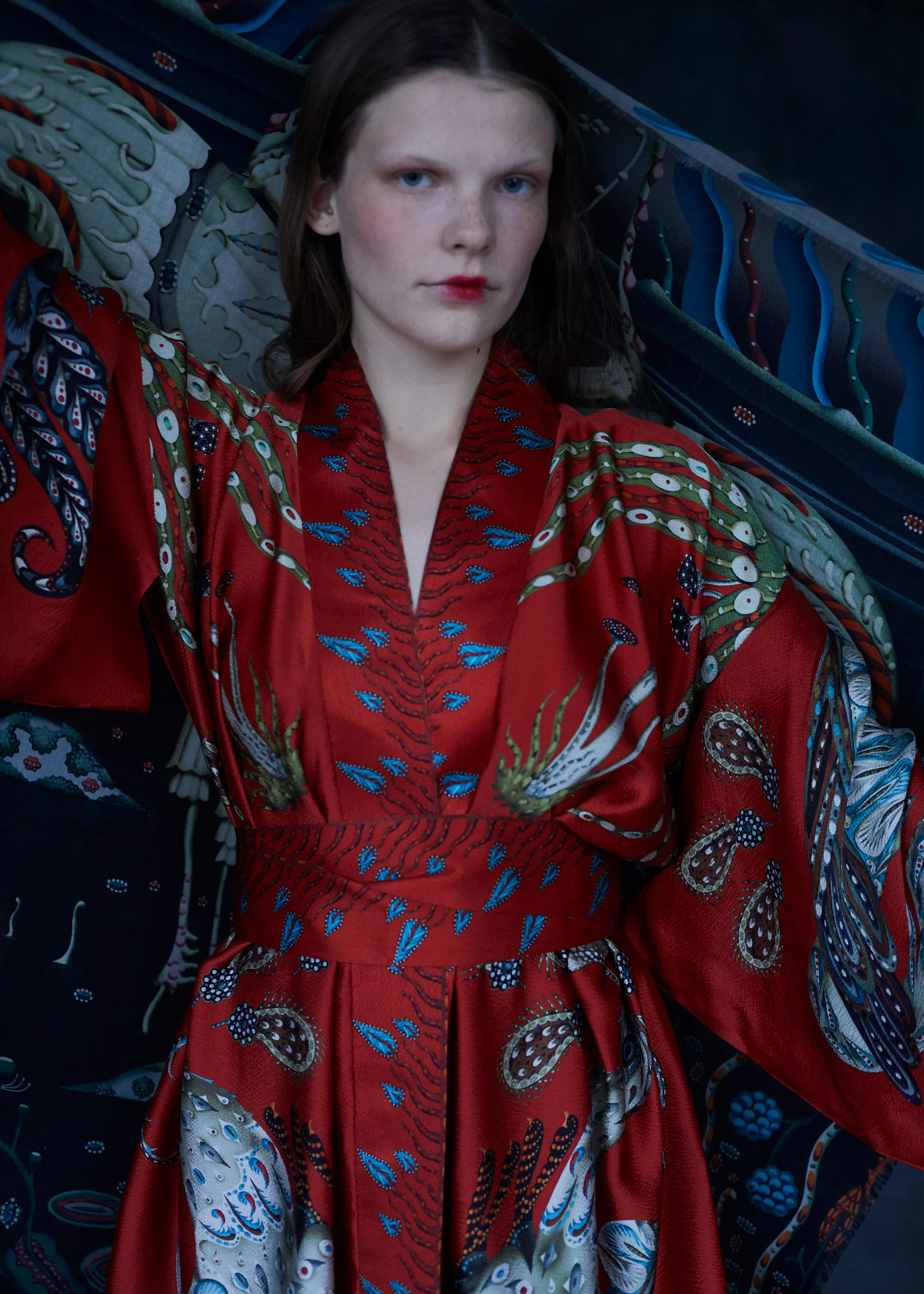
- Smooth silk is light and fluid. Our Notre Dame kimono carries magical underwater scenes in brilliant colours.
Most of our kimonos come in two sizes, S/M and L/XL, cut loose enough to wear open or closed.

How to wear a kimono at home
The kimono began life in many wardrobes as a robe, and it is still a beautiful way to start the day. Belt it loosely over sleepwear or a slip, and it turns an ordinary morning into a small occasion: coffee by the window, a book on a Sunday, an unhurried breakfast.
At home, comfort leads. Wrap the kimono closed, tie the belt at the side or the back, and roll the sleeves once if you are cooking or working. A printed kimono hung on a hook in the bedroom also earns its place as decoration. Ours are designed as pieces you are happy to have on show.

How to wear a kimono with jeans
Worn open, a kimono becomes a light coat that frames everything beneath it. This is the easiest way to take it out of the house.
- Start with a plain base. A white T-shirt, a black vest top or a fine knit gives the print room. Avoid a second pattern underneath.
- Choose straight or wide jeans. A straight leg balances the volume of the sleeves. Wide jeans give a relaxed, seventies line.
- Let it hang open. Leave the belt off or tie it loosely at the back, so the front falls in two clean lines.
- Pick one colour from the print. Repeat it in your shoes, bag or lipstick so the outfit feels connected.
- Keep the accessories light. A kimono is already a statement. Small earrings or a single ring are enough.
In autumn, layer a kimono over a thin roll-neck jumper and tailored trousers, and add a coat on top when it turns cold. The sleeves fold easily under a wide coat, and the print shows at the collar and cuffs.

How to wear a kimono as a dress
With a belt at the waist, a kimono becomes a wrap dress. This works best with longer kimonos, which give more coverage and keep the wrap in place once belted.
Cross the left panel over the right, pull the belt firmly at the natural waist, and tie it at the side. A slip or a fitted bodysuit underneath gives coverage. For evening, add heels or sleek flat sandals and a small clutch, and let the sleeves be the drama.
A kimono worn as a dress is also a good answer to a summer party or a wedding where you want colour and comfort in equal measure.
The kimono and matching trousers
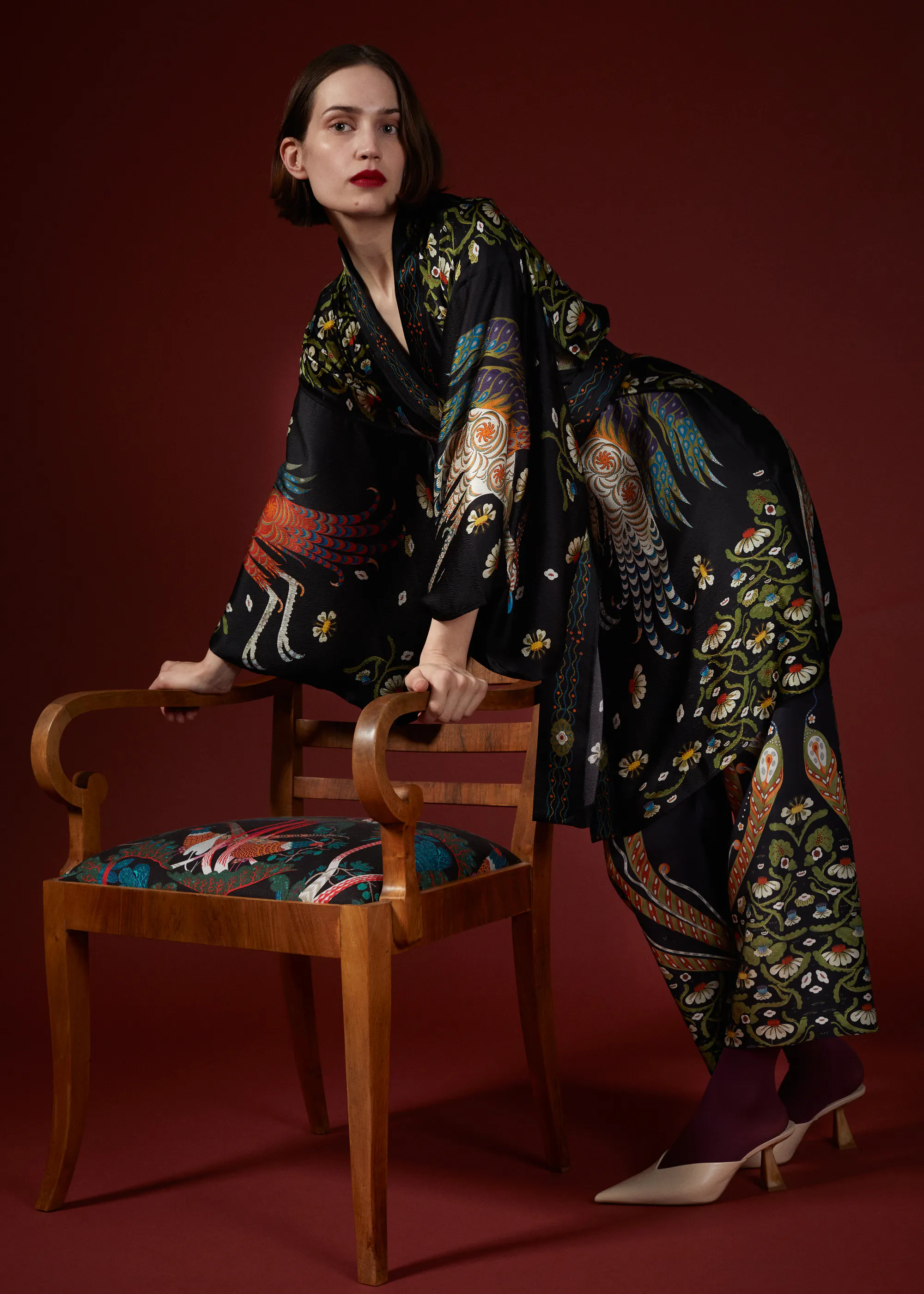
For a full look, pair a kimono with trousers cut from the same story. Our Firebird silk twill trousers are cut wide to the ankle, with an elasticated waist and a botanical and feather print that echoes the kimono. The Notre Dame kimono has its own matching trousers, printed with the same underwater world.
Worn together, a kimono and trousers read as a single, considered outfit: relaxed enough for a long lunch, rich enough for the evening. Add a plain top in a colour pulled from the print, and the look is complete. You can also wear the trousers on their own with a knit or a shirt, so the set works as separate pieces too.
Letting the print lead
A printed kimono is a piece of wearable art, so treat it as the centre of the outfit. A few principles help:
- One hero print. If you wear a printed kimono, keep everything else plain or tonal.
- Mind the scale. A large, open print looks best with simple shapes beneath it.
- Add one accent, at most. A silk scarf in a related colour, tied at the neck or on your bag, can add a second layer. Our printed silk scarves include Firebird designs that echo the kimono.
The same thinking runs through our homes as well as our wardrobes. If you like layering colour and pattern, our guide to maximalist decor brings the same approach to interiors.
Looking after your kimono
Silk lasts for years with a little care. As a natural fibre, it often needs nothing more than an airing: hang your kimono in fresh air for a while and it is ready to wear again. When it does need washing, wash it by hand in cold water or have it dry cleaned, because silk tends to lose its shine in a washing machine.
Pearl satin and hammered silk satin show water marks less readily than smooth silk satin. If a water mark does appear, take the kimono to a dry cleaner. To smooth creases, steam it or iron it inside out. Hang it on a wide, padded hanger so the shoulders keep their shape, store it away from strong sunlight, which can fade printed colour, and give it space in the wardrobe so the fabric can breathe.
Frequently asked questions
Which side do you wrap a kimono?
Wrap the left side over the right. In Japanese dress, the left panel crosses over the right for the living, and right over left is reserved for dressing the dead at funerals. With a kimono robe the same convention is a simple mark of respect for where the shape comes from.
What do you wear under a kimono?
It depends on how you wear it. Open, a kimono goes over a T-shirt, a vest top or a fine knit with jeans or trousers. Closed as a dress, wear a slip, a camisole or a fitted bodysuit underneath. At home, a kimono can be worn as a robe over sleepwear.
Are kimonos out of style in 2026?
Kimono robes have been part of fashion for decades, and a well-made printed kimono is a piece you keep for years. What lasts is the personal version: a print you love, worn in your own way, from the house to the evening.
Is it okay to wear a kimono if you're not Japanese?
Yes. Our kimono robes are not traditional kimonos: they are inspired by the Japanese cut and made for anyone to wear. A traditional kimono is longer, has different sleeves and is worn over several other garments with an obi sash. In Japan, wearing a kimono is a classic and fairly formal way of dressing, and it is not forbidden for people who are not Japanese. People wear kimonos to go shopping, for lunch, to weddings and to the theatre. If you wear one, learn how it is put on and follow its conventions, such as wrapping left over right.
Find your kimono
Choose a print you love, keep what goes underneath quiet, and wear it in as many ways as your days allow. Explore our kimonos and matching trousers, each one printed with a story.
Klaus Haapaniemi & Co. is a Finnish design house that designs, prints and produces its own homeware and clothing, founded in 2010 by designer Mia Wallenius and artist Klaus Haapaniemi.