Stories13.11.2026
Hand-Tufted vs Hand-Knotted Rugs: How Our Whales, Trees and Swan Rugs Are Made
A rug is the largest picture in a room, and the one you walk on.
When you compare hand tufted vs hand knotted rugs, the difference lies in how that picture is built. A hand-knotted rug is made on a loom, one knot at a time, so the pattern runs through the whole structure. A hand-tufted rug is made by pushing yarn through a stretched backing cloth with a hand-held tool, then finishing the back. Knotting takes longer and produces a rug that can last for generations. Tufting is faster and gives the maker remarkable freedom with colour, detail and shape.
We make both. Our Whales, Trees and Swan rugs are hand-tufted from hand-dyed wool, and our Equinoxe and Iceflower rugs are hand-knotted. Below is how each technique works, how to tell them apart, and how to choose and care for the right one.
Key takeaways
- Hand-knotted rugs are tied knot by knot on a loom; hand-tufted rugs are punched through a backing cloth by hand.
- Knotting takes longer and makes the most durable rugs; tufting allows finer illustration, many colours and shaped edges.
- Turn a rug over to tell them apart: a knotted rug shows its pattern on the back, a tufted rug has a fabric backing.
- Both last for many years in wool, with regular vacuuming, prompt blotting and the occasional turn.
How a hand-knotted rug is made
A hand-knotted rug begins on a loom strung with vertical warp threads. The weaver ties a short length of yarn around a pair of warp threads, cuts it, and moves to the next, row after row, beating each row down with a comb before starting the next. Every knot is a single point of colour, so the design is built up much like a mosaic.
Because the pile is locked into the foundation knot by knot, a hand-knotted rug is extremely strong. The fringe at each end is the warp itself, finished by hand. The work is slow: a large rug can take a team of weavers many months.
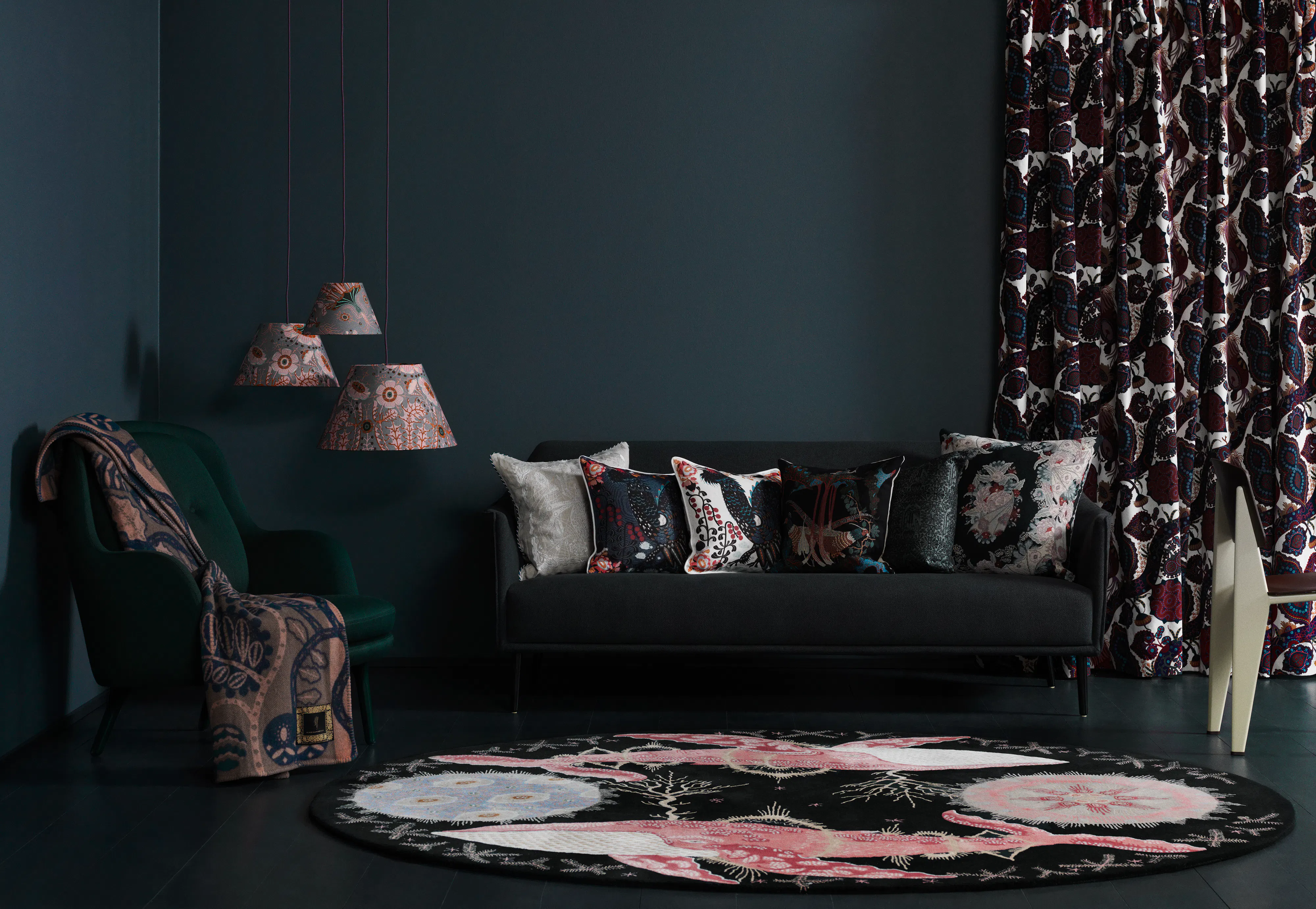
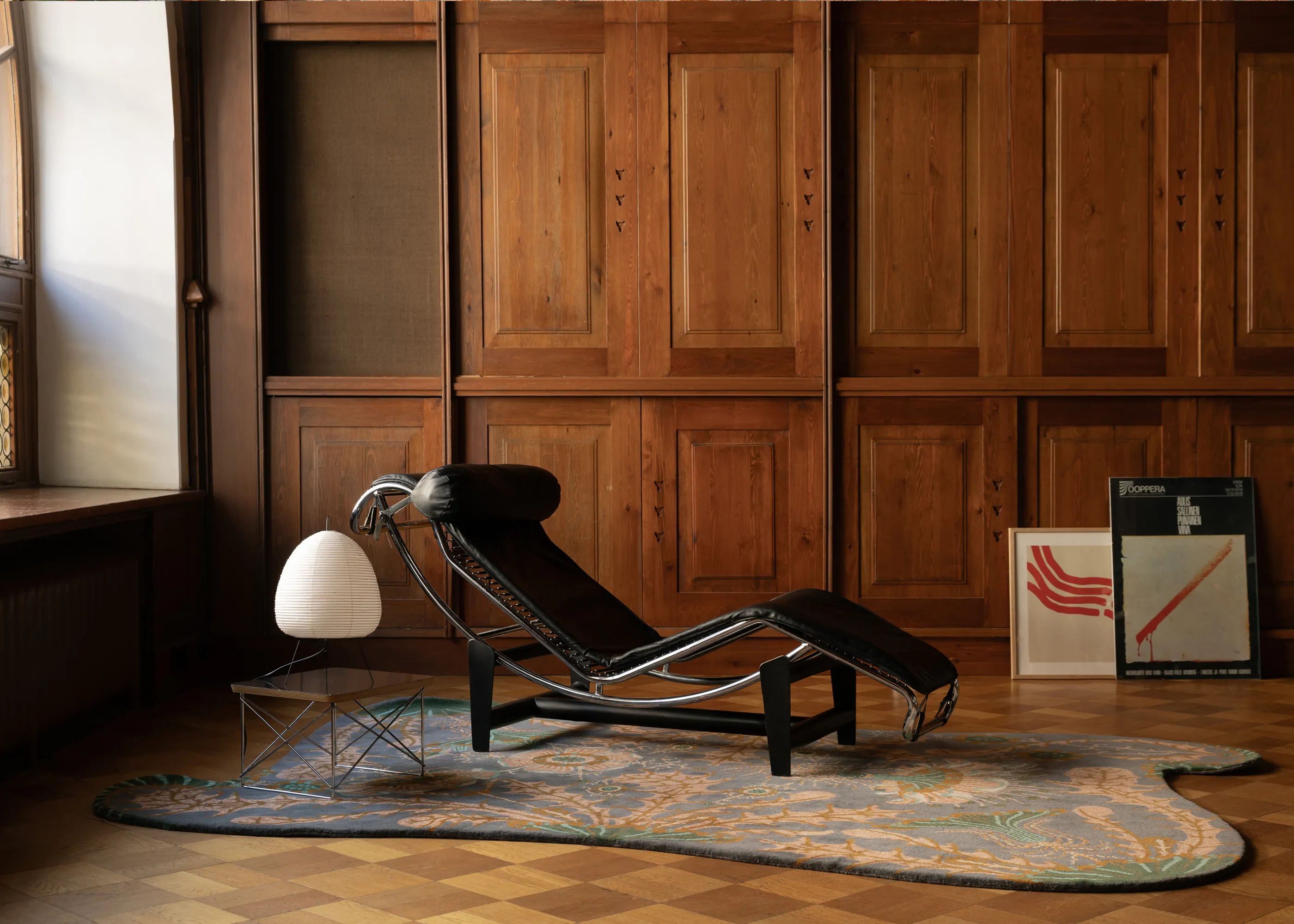
Our Equinoxe hand-knotted wool carpet is made this way by skilled artisans in Varanasi, India. Its flowing Art Nouveau curves have a depth and texture that only improve with time, and it can be made to measure.
How a hand-tufted rug is made
A hand-tufted rug begins with a cloth stretched tight on a vertical frame. The design is drawn onto the cloth at full size, and the maker follows it with a hand-held tufting tool, pushing loops of yarn through the cloth, colour by colour. Once the face is complete, the back is sealed and covered with a second cloth, and the pile is sheared and carved by hand so the edges of each shape stand out.
Tufting suits illustration. The maker can follow every curve of a drawing, change colour as often as the design asks, and shape the rug itself, which is how an oval or a silhouette becomes possible. For an artist whose work is full of creatures, branches and fine detail, that freedom matters.
Whales, Trees and Swan: our hand-tufted rugs
Our hand-tufted rugs are limited editions, made from pure wool in sixteen shades of hand-dyed yarn. Each one turns a Klaus Haapaniemi drawing into something you can stand on.
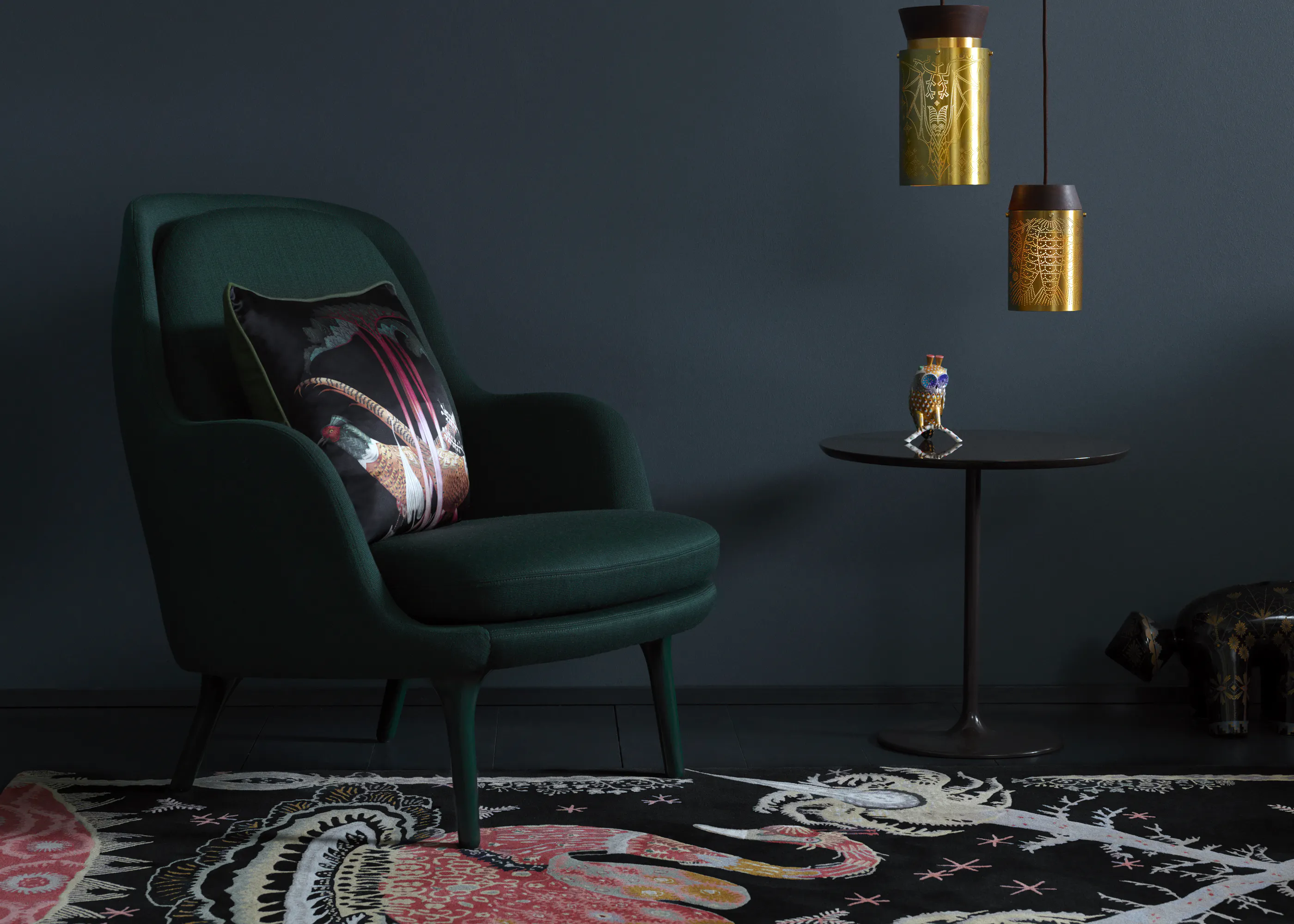
- Whales is an oval rug, 240 x 200 cm. Two coral-pink whales swim across a deep navy ground among sea plants, starfish and round, flower-like medallions. The oval shape suits a round table or the centre of a living room.
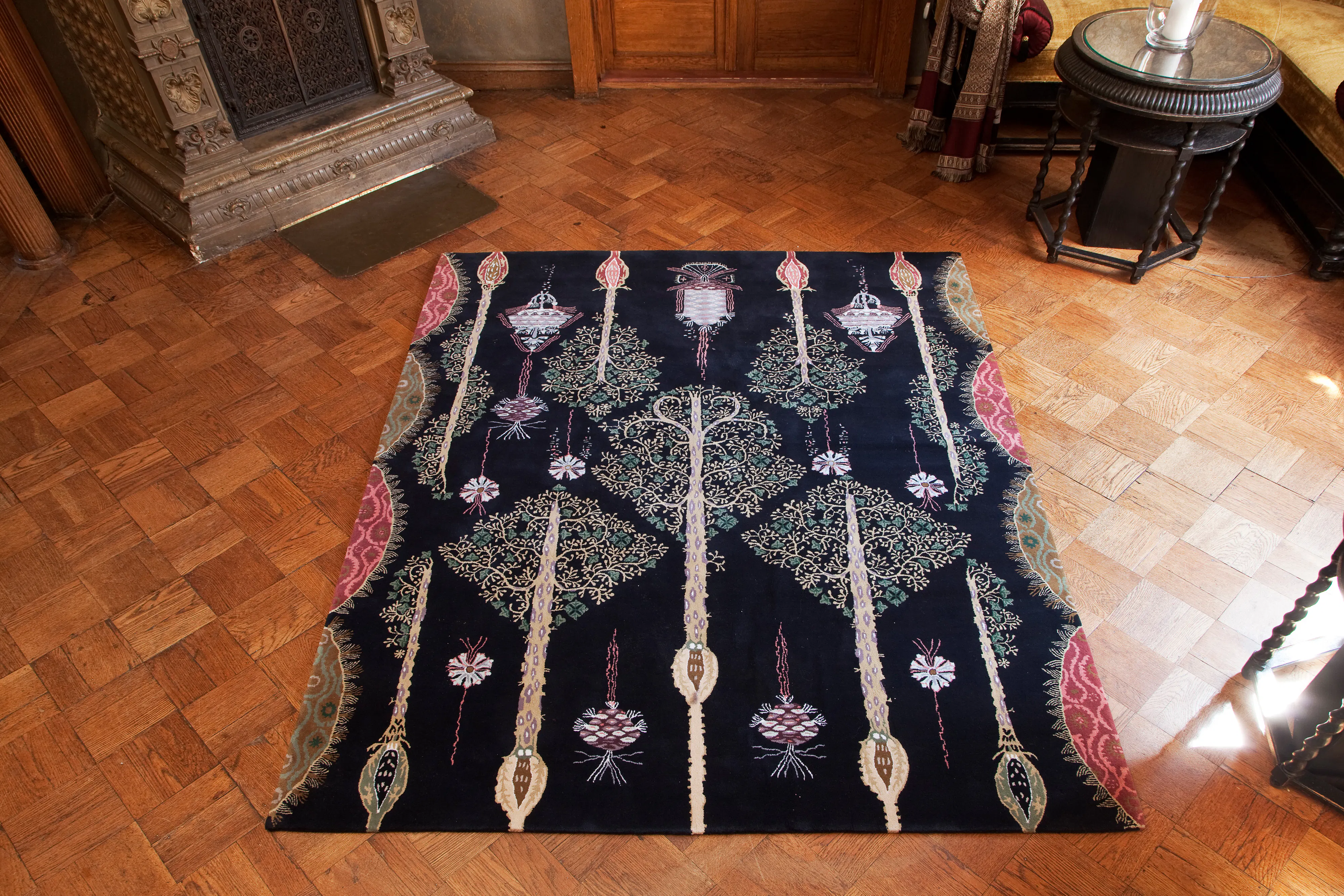
- Trees measures 180 x 220 cm. Golden trees with blue-green leaves rise from a black ground between tall seed pods, framed along the sides by red and green scalloped forms. A special extra-large edition measures 300 x 279 cm.
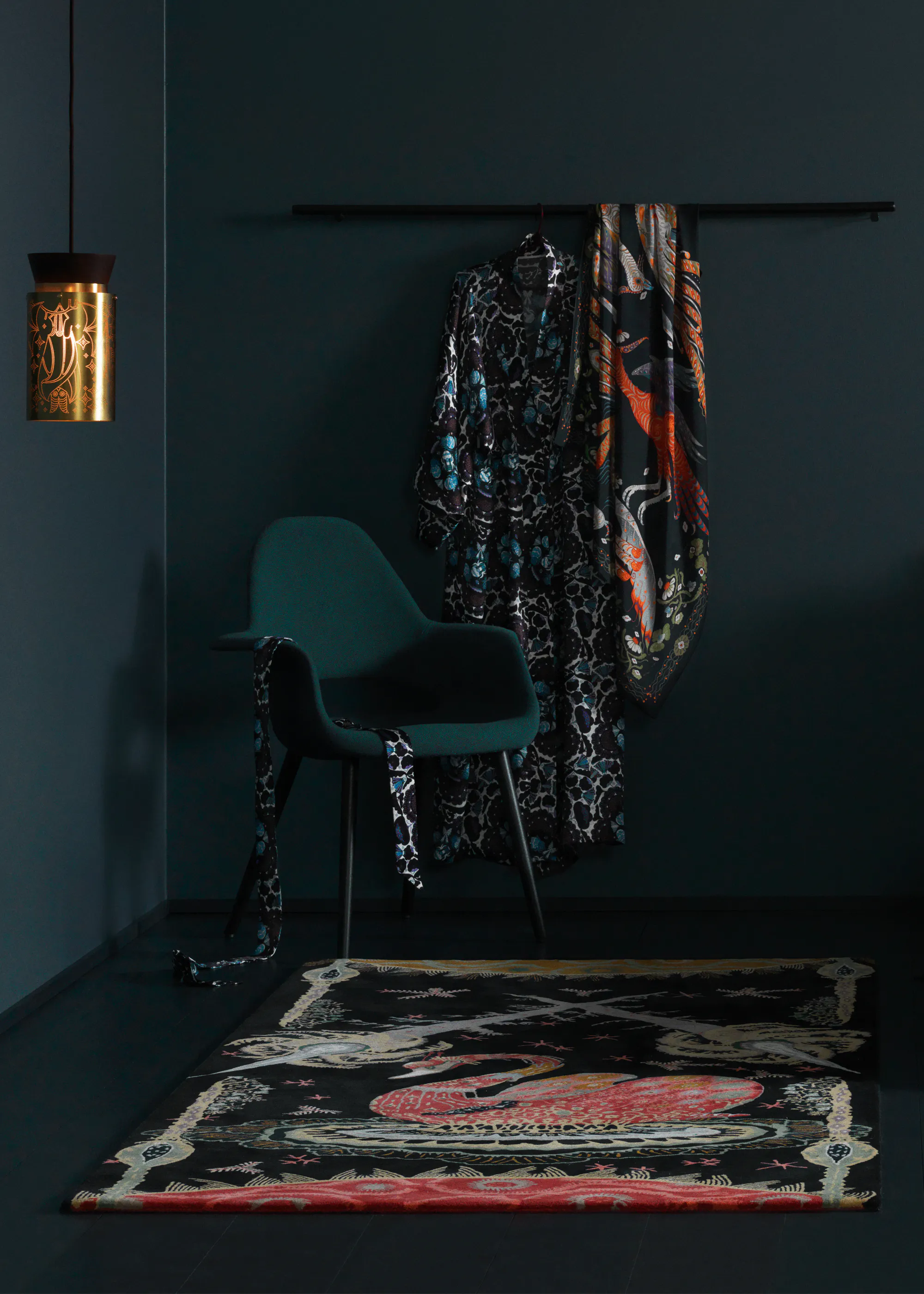
- Swan is a long rug, 120 x 240 cm. A red, richly patterned swan rests on a pool at its centre, watched by two pale birds whose long necks cross above it, under a scatter of pink stars. Its proportions suit a hallway or the foot of a bed, and it is striking enough to hang on a wall.
The rugs are made to order with a lead time of up to sixteen weeks, so each one is tufted for its new home.
How to tell if a rug is hand-knotted or hand-tufted
Turn a corner of the rug over and look at the back.
- Hand-knotted: the back shows the pattern clearly, almost as sharp as the front, with small irregular knots visible across it. The fringe is part of the rug's structure, the ends of the warp threads.
- Hand-tufted: the back is covered with a plain fabric backing, often canvas or cotton, and the pattern is hidden. Any fringe has been sewn on separately.
Price and time are the other clues. A rug that would take months to knot by hand will cost more than a tufted rug of the same size and fibre.
Are hand-tufted rugs good quality?
Quality depends on the materials and the hands that made it. A hand-tufted rug in dense, pure wool, made by experienced craftspeople, is soft underfoot, holds its colour and wears well for many years. A cheap tufted rug made from thin pile and synthetic fibre will not.
The real choice is between two kinds of value. A hand-knotted rug is an heirloom built to outlast its first owner. A hand-tufted rug offers more freedom in design, a shorter wait and a lower price for its size, which is why it is the natural technique for richly illustrated pieces.
Choosing the right size and shape
A rug defines a zone in a room, so measure the space first and mark the outline with tape before you order.
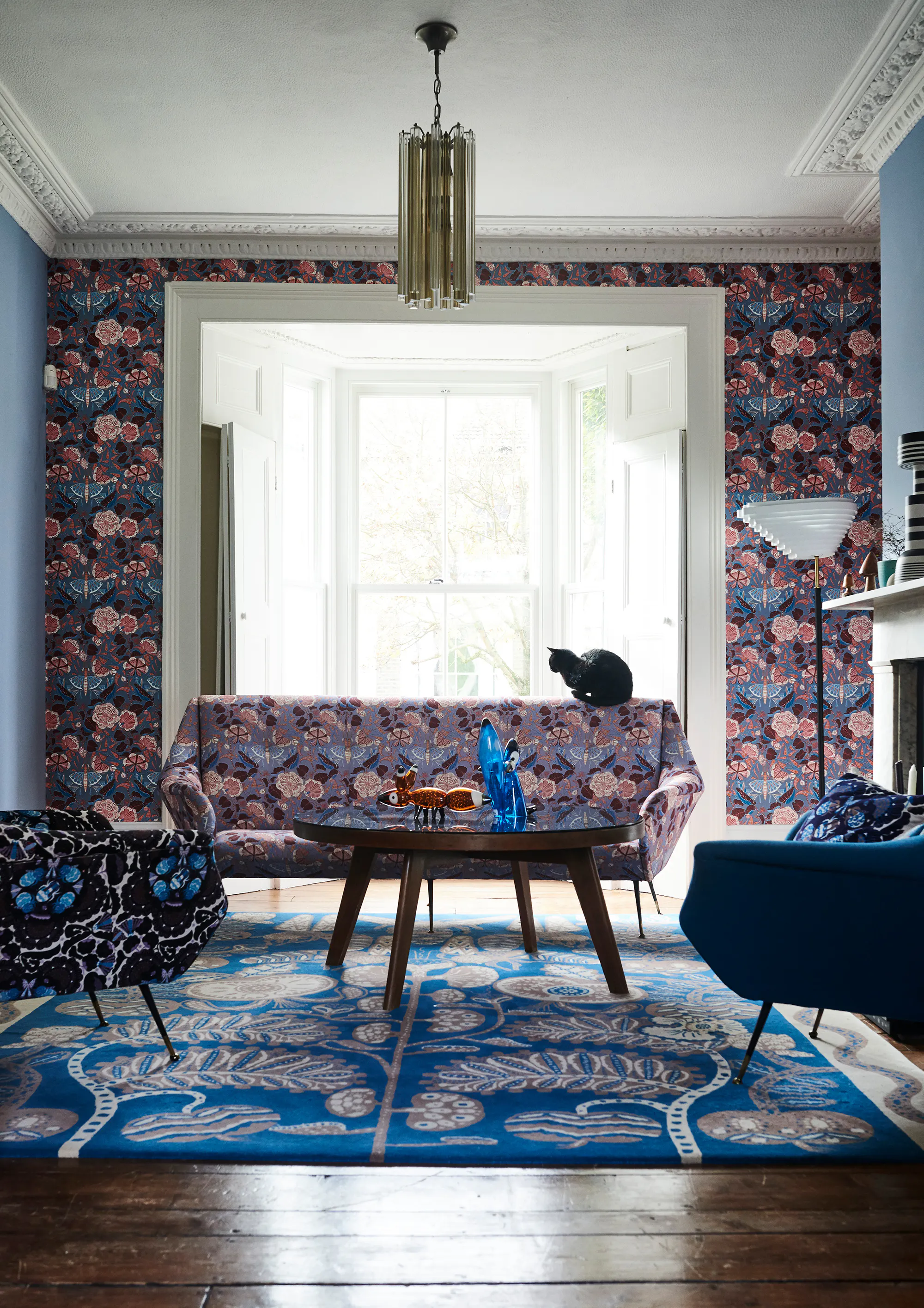
- In a living room, choose a rug large enough for at least the front legs of the sofa and armchairs to rest on it. This ties the seating together.
- Under a dining table, allow enough room for the chairs to be pulled out without catching the edge. An oval rug, like Whales, suits an oval or round table.
- In a bedroom, place the rug so it extends beyond both sides of the bed, or lay a long rug, like Swan, across the foot of it.
- In a hallway, a long, narrow rug leads the eye along the space and softens footsteps.
For a room led by a strong rug, keep the other patterns in a supporting role. Our guide to maximalist decor shows how to build a room around one hero print.
How to hang a rug on the wall
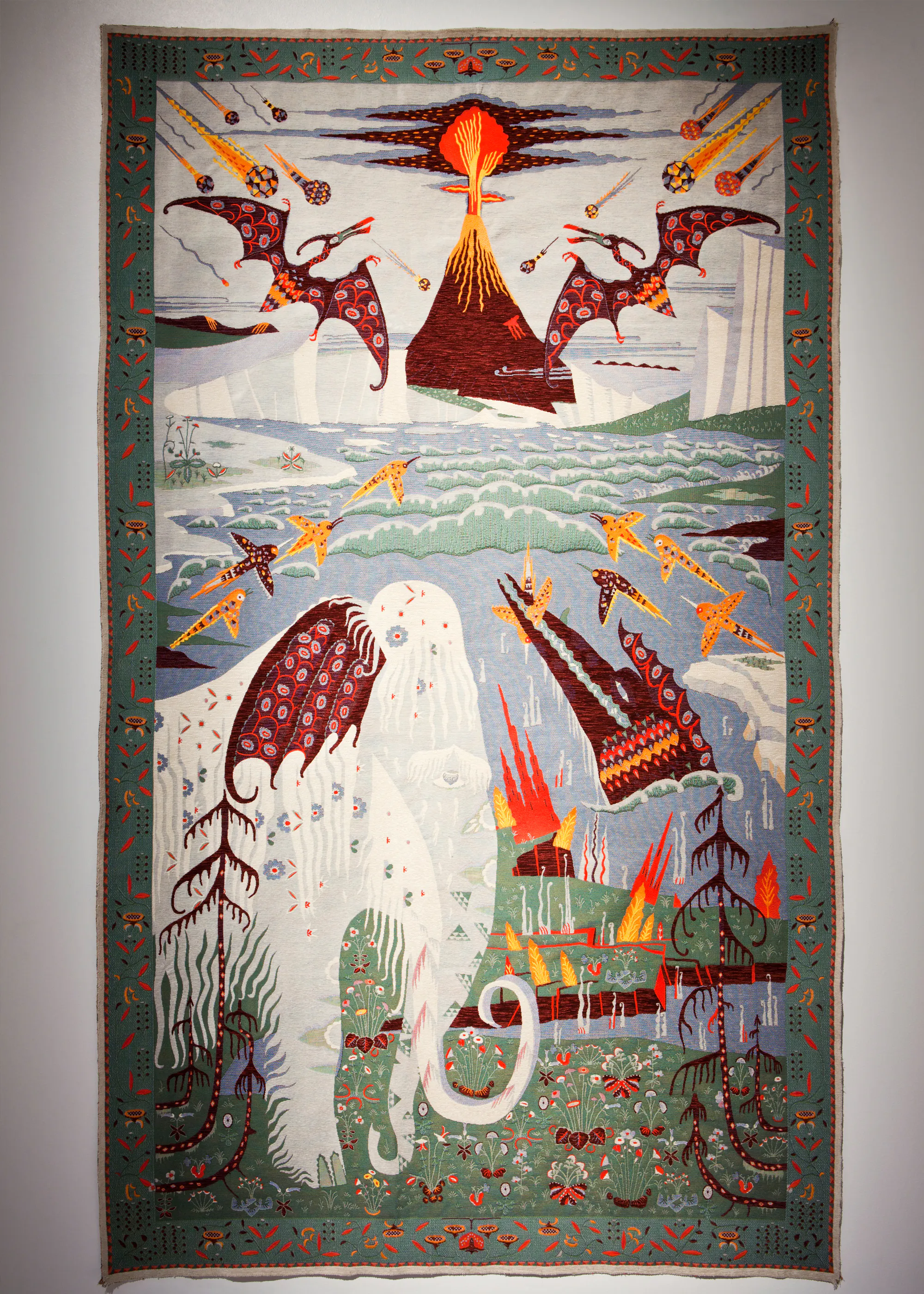
A rug is a textile artwork, and some pieces deserve the wall. In Finland, the ryijy has a long history, first as a warm cover for the bed and later as a woven picture for the home. Our Purple Haze rya rug, 400 x 200 cm, was woven in 2012 by the art weavers Kariina Linna and Sanna Reinikainen for The Friends of Finnish Handicraft, and it works as a rug or a wall hanging.
To hang a rug safely:
- Spread the weight. Sew a strip of hook-and-loop tape or a fabric sleeve along the full width of the back, near the top edge. Avoid nails driven through the rug itself, which damage the weave.
- Fix a batten to the wall. Attach the matching hook-and-loop strip to a wooden batten, or slide a rod through the sleeve and rest it on brackets.
- Keep it out of direct sun. Light fades wool over time, so choose a wall away from strong sunlight.
- Ask for help with large pieces. A big rug is heavy. For anything of real size or value, a textile conservator or professional hanger can advise on the best fixing.
How to care for a wool rug
Wool is naturally resilient and resists dirt well, so a little regular care goes a long way.
- Vacuum regularly with suction only, or with the brush bar switched off, working in the direction of the pile.
- Expect some shedding at first. New tufted and knotted wool rugs release loose fibres for the first few months. Regular vacuuming clears them.
- Blot spills straight away with a clean, dry cloth, working from the outside in. Do not rub.
- Turn the rug every six months so it wears and fades evenly.
- Use a rug pad underneath to stop it from slipping and to protect the backing.
- Have it professionally cleaned when it needs a deep clean, by a specialist in handmade wool rugs.
Frequently asked questions
Are hand-knotted rugs worth it?
For a piece you want to keep for decades and perhaps pass on, yes. Every knot is tied by hand, the pattern runs through the whole structure, and a well-made hand-knotted wool rug can last for generations. The trade-off is a longer making time and a higher price.
How long does a hand-tufted rug last?
A hand-tufted rug in dense, pure wool lasts for many years with regular care. Vacuum it often, deal with spills straight away, use a rug pad and turn it every few months, and it will keep its colour and pile for a long time.
What is the difference between hand-tufted, hand-knotted and hand-loomed?
Hand-knotted rugs are tied knot by knot on a loom. Hand-loomed rugs are woven on a hand-operated loom, which is faster than knotting. Hand-tufted rugs are made by pushing yarn through a backing cloth with a hand-held tool. All three are made by hand, but knotting takes the longest.
Can you put a rug on the wall?
Yes. Sew a strip of hook-and-loop tape or a fabric sleeve along the back, near the top, and hang it from a batten or rod so the weight is spread evenly. Keep it away from direct sunlight to protect the colours.
Find your rug
Choose the technique that suits the way you live, and a design you are happy to see every day. Explore our rugs and carpets, each one drawn by Klaus Haapaniemi and made by hand.
Klaus Haapaniemi & Co. is a Finnish design house that designs, prints and produces its own homeware and clothing, founded in 2010 by designer Mia Wallenius and artist Klaus Haapaniemi.